The web writer’s job has changed a lot in two years. Today, producing quality SEO content requires orchestrating multiple steps: keyword research, SERP analysis, writing, optimization, proofreading, publishing. Web writing tools have multiplied in parallel, from simple free word processors to platforms supercharged with artificial intelligence.
Here’s our pick of the solutions worth knowing if you want to build solid organic search rankings without spending your nights on it.
TL;DR: the SEO web writing tools comparison at a glance 30-second read
Here’s the express version: a comparison of web writing tools and platforms (free or paid) that help web writers produce quality SEO content optimized for search engines. Category, strength, limit: scan it in 30 seconds and pinpoint your need before going any further.
| Tool | Category | Main strength | Main limitation |
|---|---|---|---|
| Wisewand Our tool | All-in-one French SEO AI platform | Covers the entire chain, from writing to automated publishing | Paid solution, starting at €0.79 excl. VAT per article |
| Google Docs with Gemini | Universal word processor | Free, collaborative, one-click sharing | No native SEO optimization |
| Frase | SERP-based SEO briefs | Structured briefs in just a few minutes | English-only interface, paid, doesn’t cover writing |
| ChatGPT and Claude | General-purpose LLMs | Brainstorming, rephrasing and assisted writing | No SERP analysis or native SEO score |
| Surfer SEO, Thot SEO and YourTextGuru | On-page optimizers | Real-time semantic score and lexical field | Writing happens elsewhere, extra subscription |
| Antidote | Spelling and grammar checker | Flawless spelling, grammar and style | No SEO or editorial added value |
| WordPress with Yoast SEO or Rank Math | Publishing CMS with SEO checks | Basic SEO safeguards at publish time | Doesn’t generate or optimize the content upstream |
Wisewand, the complete solution that writes, optimizes, interlinks and publishes
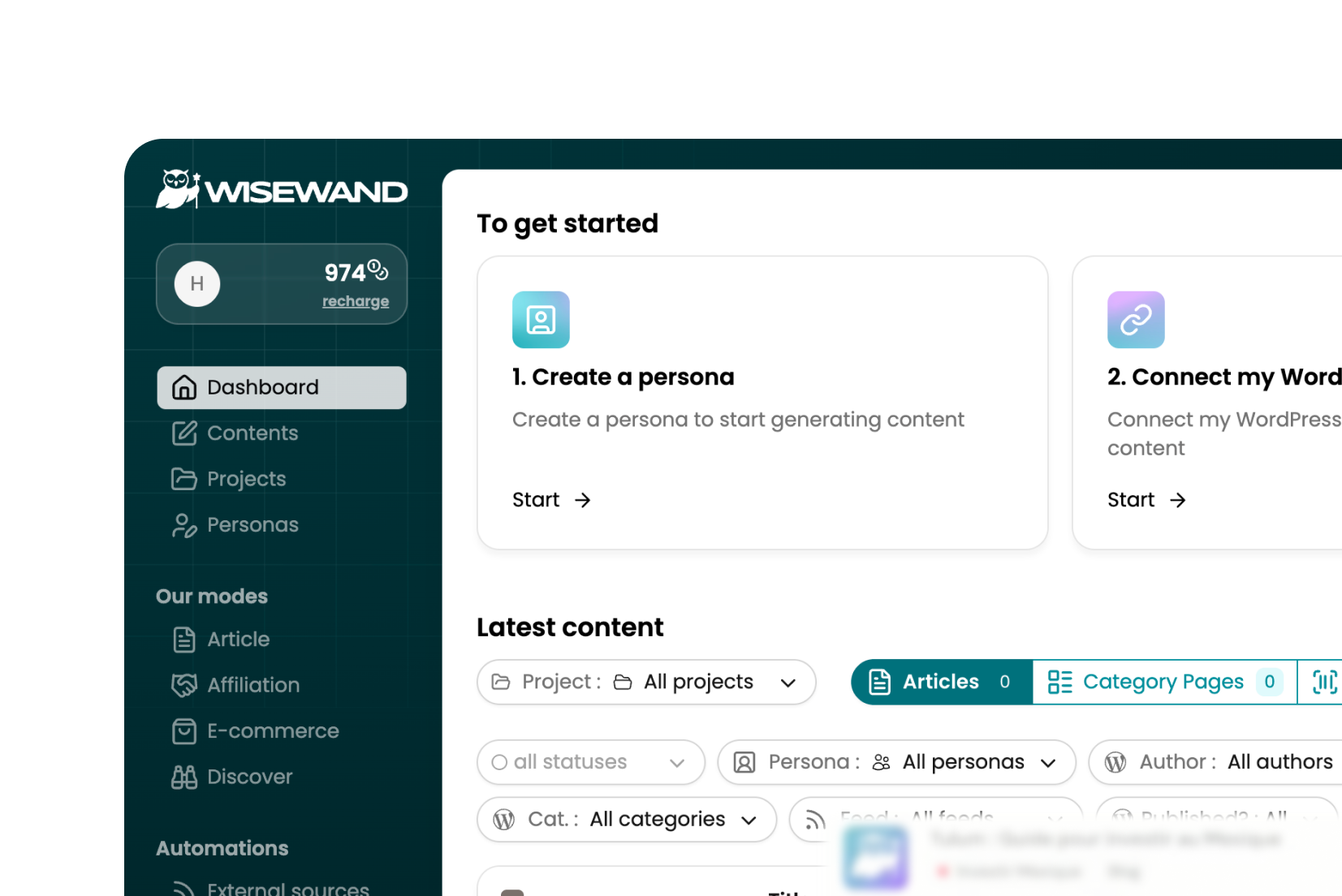
Meet Wisewand, our French writing platform, designed for site publishers who produce at volume. A single interface brings together semantic analysis, AI-powered content generation, SEO optimization and publishing. Today, more than 650 publishers and agencies trust us with their content marketing.

Full coverage of the SEO writing workflow
From analysis to publishing, Wisewand handles every step of your work:
- real-time SERP analysis on your target keyword
- generation of articles optimized for search engines
- creation of product sheets at scale
- Discover mode to target Google’s recommendation feed
- SEO score calculated as you write
- automatic internal linking between your pages
- image generation via Flux AI
- rich formatting and integration of relevant YouTube videos
Five generation modes adapt to your goal:
- Autopilot
- Advanced
- Affiliation
- E-commerce
- Discover
And thanks to SEO personas, every article adopts your tone and editorial style.
Automations that put your production on autopilot
Once the writing is dialed in, Wisewand takes over distribution. Four automation channels are available to you:
- the official WordPress plugin for direct publishing
- the Make module developed by Sequance to orchestrate your workflows
- the public API to plug Wisewand into your internal tools
- webhooks and N8N to push things even further
Industry mode adds a strategic layer: a single Google Sheet can pilot multiple websites at once. And the External Sources feature feeds your site daily with publications from your competitors, with zero manual intervention.

Google Docs with Gemini, the universal text editor
Different angle. Not every freelance web writer wants an integrated platform. Some are looking for a free tool, smooth and shareable online for their daily writing. Google Docs has been ticking those boxes for years. With Gemini built in, the word processor now adds rephrasing suggestions and a nudge to unblock a paragraph when inspiration runs dry.
Five strengths make it the web writer’s default companion:
- smooth online editing from a simple browser
- easy sharing and access for your clients or collaborators
- real-time comments and suggestions for multi-person collaboration
- unlimited storage on Google Drive
- a free version that’s more than enough for everyday use
The catch? Google Docs sticks to its general-purpose document nature. No SERP analysis, no optimization score, no automatic interlinking. Every article therefore demands manual work to improve its SEO quality. And if you really want to rank your texts online in search engines, you’ll have to round out this tool with other dedicated software.
Frase, the SEO brief expert
Speaking of which, let’s talk about a tool used by SEO agencies and publishers who industrialize their production: Frase. The idea? Before you even write the first line, you launch a semantic analysis of the target SERP and get a ready-to-use SEO brief in a few minutes. This tool examines the best-ranking pages and compiles:
- the outline structure adopted by well-ranked pages
- the questions users ask about your topic
- the semantic keywords to include
- the headings used by your competitors
- SEO content coverage statistics
Five features sum up its practical value:
- SERP analysis
- detailed brief generation
- user question suggestions
- semantic keyword research
- SEO optimization score
The catch: writing happens elsewhere, the interface is in English, and the paid version climbs fast as your volume grows. Frase preps the ground but doesn’t close the loop.
ChatGPT and Claude, general-purpose LLMs for ideation and assisted writing
Frase preps the ground, but eventually you have to write. That’s where the language models that shook up content creation come in. A word of caution though: these AI conversational assistants help you brainstorm, unblock a stubborn intro, rephrase a paragraph or find a synonym, but they never become full-fledged SEO producers. At least not as-is.

ChatGPT, the most accessible LLM for brainstorming
ChatGPT is the historic gateway to generative AI for the general public. Several strengths explain its popularity among web writers:
- an intuitive interface
- a free version that’s generous for daily use
- an ecosystem of custom GPTs and extensions
- an ultra-active community everywhere on social media
Four typical use cases stand out in content writing:
- brainstorming ideas
- quick article outlines
- paragraph rephrasing
- finding synonyms
The issue: with no connection to your website and no knowledge of your editorial line, ChatGPT ignores your target keywords and completely skips SERP analysis.
Claude, the ally for long, nuanced content in French
Claude plays in another league with demanding French-speaking writers. Its favorite playground: long, dense and nuanced content. Four strong points stand out:
- above-average mastery of written French
- tone fidelity across long texts
- finer reasoning on complex or technical topics
- the ability to digest a detailed brief in a single conversation
Its generous context window helps process several documentary sources without breaking a sweat. Same limitation as ChatGPT though: Claude will back you up on writing, never on native SEO ranking.
Surfer SEO, Thot SEO and YourTextGuru, the on-page optimizers
On the pure SEO optimization side, three names keep showing up in seasoned web writers’ workflows.
- Surfer SEO plays the international reference card, with a real-time optimization score and recommendations pulled from the SERPs.
- Thot SEO applies the same logic, but with a French interface adopted by many French-speaking SEO agencies.
- YourTextGuru stands as the historic name of the French-language lexical field: its guides list precisely which expressions to slot in to validate a topic in Google’s eyes.
Four points unite these three solutions:
- a real-time optimization score
- semantic analysis based on SERPs
- recommendations of keywords to include around your main keyword
- integration via a third-party editor or simple copy-paste
Antidote, the reference proofreader for clean texts
Beyond optimization, content quality always starts with clean spelling. Antidote serves as the quality stamp for written French among professional web writers who publish at scale. Six functions structure its writing assistance:
- spell-checking
- grammar checking
- syntax checking
- style suggestions
- built-in dictionaries
- language guides
This spell-checker integrates with Word, Google Docs, browsers and most everyday word processors. Real-time correction prevents spelling mistakes and gives your articles that flawless style essential to your credibility, especially when you publish at volume across multiple websites.
Four levels of correction cover the entire writing workload:
- spelling
- grammar
- syntax
- style
Limit to keep in mind: Antidote corrects the form, never the substance or SEO optimization. A text without a single typo will never appear in the top results if it misses its topic.
WordPress with Yoast or Rank Math, the final publishing platform
Once written, optimized and proofread, the article has to land somewhere. And in the vast majority of cases, that somewhere is WordPress: this CMS still hosts the bulk of content sites on the internet. Two reference SEO plugins guide web writers at publish time, Yoast SEO and Rank Math, scrutinizing your pages before you hit the publish button.
Five practical checks happen at the moment of going live:
- the title tag
- the meta description
- the main keyword in the title and URL
- text readability
- image alt tags
Watch out though: Yoast SEO and Rank Math act as safeguards, never as content producers. Everything has to be written and optimized upstream, as you’ll have understood.
Conclusion: stack tools or centralize in Wisewand?
You’ve got the full picture. The question now: which one (or several) really fits your content production work? Here’s a mini comparator to settle it in a few clicks.
Which tool for which need?
Pick your needs, we’ll highlight the tools that cover them all.
Wisewand
4 needs out of 4
- Writing
- SEO optimization
- Publishing
- Automation
Google Docs with Gemini
1 need out of 4
- Writing
- SEO optimization
- Publishing
- Automation
Frase
1 need out of 4
- Writing
- SEO optimization
- Publishing
- Automation
ChatGPT
1 need out of 4
- Writing
- SEO optimization
- Publishing
- Automation
Claude
1 need out of 4
- Writing
- SEO optimization
- Publishing
- Automation
Surfer SEO, Thot SEO and YourTextGuru
1 need out of 4
- Writing
- SEO optimization
- Publishing
- Automation
Antidote
0 needs out of 4
- Writing
- SEO optimization
- Publishing
- Automation
WordPress with Yoast SEO or Rank Math
1 need out of 4
- Writing
- SEO optimization
- Publishing
- Automation
A quick aside on Antidote: it targets a different need from those in the comparator, namely correcting written French. Historically, it was a reflex for writers producing by hand. In the era of language models, its usefulness is gently eroding: modern AIs naturally make very few spelling or grammar mistakes. Antidote still makes sense if you edit a lot by hand, a bit less when your stack is already AI-driven.
Stacking 5 or 6 different tools means as many subscriptions, interfaces and round-trips eating away at your time every day. Wisewand consolidates writing, SERP analysis, semantic optimization, internal linking, publishing and automation into a single French platform. Quick math: less friction, more output, costs slashed. The choice becomes obvious once you look at the numbers.