Why do some articles rank on the first page while others stay invisible? The answer comes down to a few organic search techniques anyone can apply.
Search intent, clean structure, integration of relevant keywords, smart internal linking, image optimization: these are all elements that boost your visibility on search engines.
This article shows you concretely what an SEO-optimized article example looks like. You’re going to understand how to create content that attracts readers and climbs in Google, in two shakes of a lamb’s tail.
Why not all articles are equal in SEO
Google analyzes dozens of criteria before deciding whether your article deserves the first page or whether it’ll stay invisible (because you know the SEO saying: “The best place to hide a corpse is on the second page of Google”).
Among these criteria, you’ll find:
- Content relevance compared to the user’s key query
- The quality of the writing and the added value brought to the reader
- The structure of the article and the use of H1 and H2 tags
- The natural integration of relevant keywords within the text
- Internal linking and external links to trustworthy sources
- Image optimization and visual elements
- Content freshness and regular updates
- The consistency of the semantic and lexical fields
On this impressive list, some criteria carry more weight than others on the organic search scale. We’re going to detail a few of them in this article to give you the example of an SEO-optimized article.
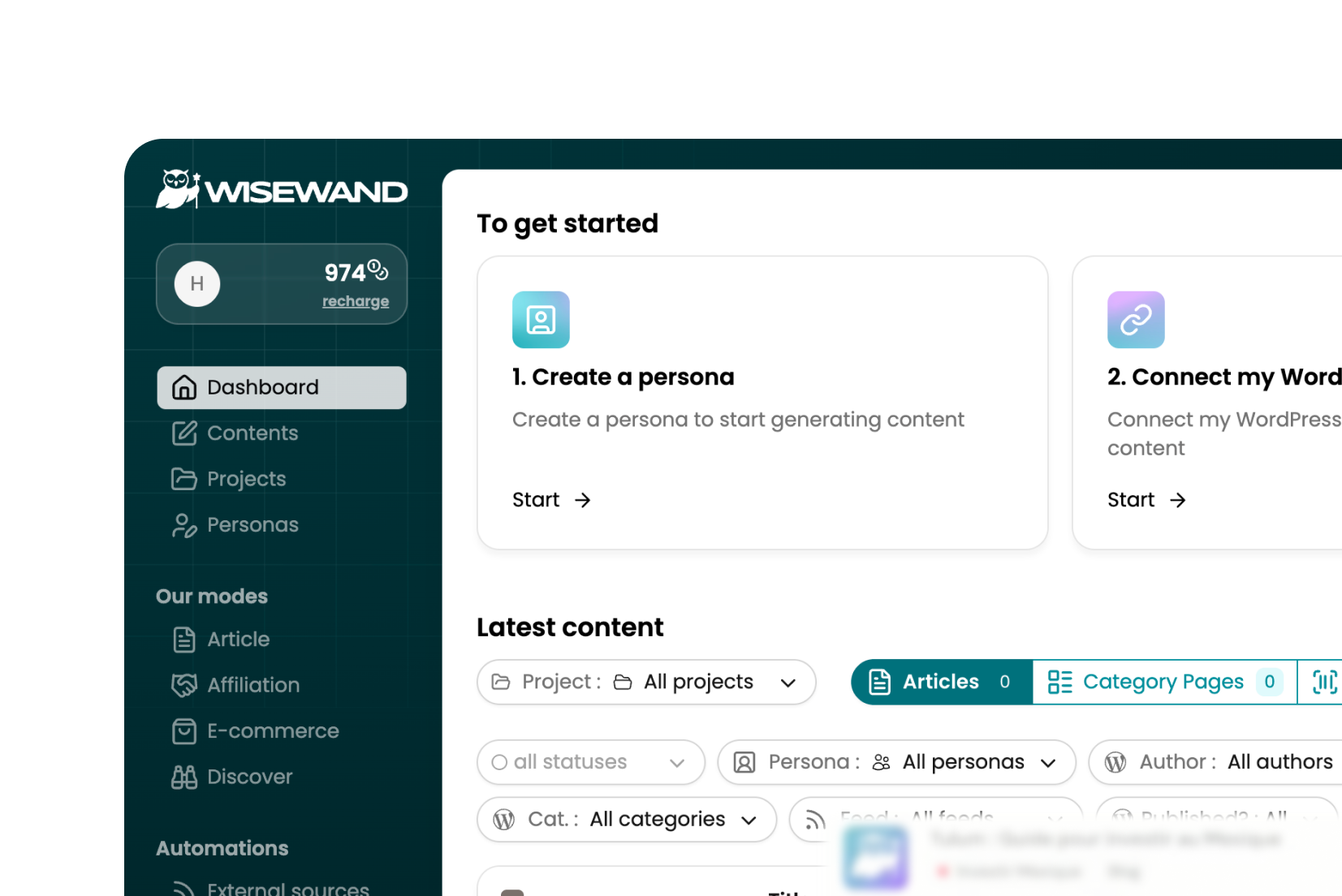
The good news? A tool like Wisewand automatically analyzes these criteria when creating your content with the goal of maximizing your chances of climbing in the search engines, without spending hours on it.
Search intent: understanding what users really want
Before even writing a single line, you have to ask yourself this question: what is the user really looking for when they type their query into Google? It’s the absolute starting point of any high-performing article. Without that understanding, you risk producing content that doesn’t meet expectations, and therefore missing out on qualified traffic.
Search intent is the real need behind a key query. In concrete terms, a user is trying to:
- Get information on a specific subject (informational search: “what is SEO”)
- Reach a specific website or page (navigational search: “Wisewand login“)
- Compare solutions before making a decision (commercial search: “best web copywriting tool”)
- Buy a product or service (transactional search: “buy SEO writing tool”)
To identify intent, analyze the SERP, that famous Google search results page. It’s a real goldmine of information. Look at the titles of the top articles, the featured snippets and the “people also ask” boxes. These elements tell you the type of content expected: practical guide, comparison, tutorial, FAQ, in-depth study. You also discover the level of detail people are after, the topics to cover, the ideal format.
Wisewand automatically analyzes the best-ranking content to precisely identify what users expect. The tool relies on SEO personas to adapt the style and tone of every piece of content to your target audience. Result: articles that directly answer your audience’s questions.
Create my first optimized article with Wisewand
The structure of an SEO-optimized article
Good content is a bit like a well-built house: without solid foundations, everything collapses. Your article’s structure matters enormously, both for Google and for your readers. It makes things easier to understand, improves user experience and boosts your visibility.
A clear and logical heading hierarchy
The Hn tags (H1, H2, H3) organize your content and help Google understand the structure of the article. Here are the rules to follow: only one H1 per page (your main title), H2s for your main sections, and H3s for the subsections. This hierarchy guides the reader through the page and signals the most relevant information to search engines.
A structured outline with optimized subheadings makes people want to stay on the page. That’s why Wisewand automatically generates a logical and effective article structure that saves you precious time.

The title tag and meta description: your storefronts in Google
The title tag and the meta description appear in the search results and determine whether the user clicks on your link or not. Here are some practical tips for optimizing them:
- Include your main keyword right at the beginning of the title tag
- Stay within the character limits: 60 for the title, 160 for the meta description
- Make people want to click with attractive wording and a concrete example
- Provide a clear answer to the user’s question
Wisewand generates these optimized elements automatically, with no effort on your part.
Never neglect the introduction and conclusion
The introduction grabs the reader’s attention from the very first lines and previews what they’re going to discover. The conclusion summarizes the main information and prompts action. Here’s how to make them effective:
- Start with a question or an observation to grab attention
- Present the key steps or the main points covered
- End with a clear call to action: download a guide, try a tool, share the article
- Add value with a practical tip or a useful summary
These two parts frame your content and make reading flow smoothly from start to finish.
The natural integration of keywords
The era of keyword stuffing is over. Google easily detects these techniques and penalizes them. Today, the priority is the natural and intelligent integration of keywords into your SEO copy. The goal: create quality content that’s readable and pleasant, while optimizing your business’s search performance.
The main keyword is your through-line
Your main keyword should appear in strategic places:
- the H1 title,
- the first paragraphs of the body text,
- the title and meta description tags,
- and the URL of your page.
Watch out: the integration has to stay fluid and natural. A reader should be able to scan your article without noticing forced repetition.
The idea: use varied phrasing and place the keyword where it actually makes sense. Wisewand has mastered this writing technique and follows the best practices for effective SEO optimization. You get content optimized for search, with no extra effort.
Secondary keywords and the semantic field
Beyond the main keyword, enrich your text with related terms and variations. The semantic field and the lexical field bring relevance to your SEO content. Here are some practical tips:
- Add synonyms and expressions related to the main subject
- Target long-tail keywords, more precise and less competitive
- Integrate terms used by your target audience in their searches
- Vary the phrasing to avoid repetition and improve SEO
This semantic approach helps Google better understand your content and rank it for a wider range of queries.
Internal linking to smartly connect your content
Internal linking is the art of connecting your pieces of content together via contextual links. This organic search technique plays a major role in your SEO strategy.
First, it distributes the “link juice” across your pages, which helps Google better gauge the importance of each piece of content. Then, it improves navigation on your website and makes related information easier to access. Finally, it strengthens the topical relevance of your content by creating logical bridges between your different subjects.
Here are some practical tips for effective internal linking:
- Create links to transactional pages or blog posts that are relevant and directly tied to the topic at hand.
- Vary your link anchors: use natural phrasing rather than always the same keyword.
- Think about the user experience by placing your links where they bring real added value. A reader should be able to dig deeper into a point without breaking their reading flow.
Wisewand analyzes the existing content on your website and proposes smart internal linking, optimized automatically. The tool spots relevant link opportunities and integrates them into your new articles. You save time and get a coherent structure without even thinking about it.

Images: more than illustration, an SEO asset
Images don’t only serve to decorate your blog posts. They improve the user experience, make your content more attractive and can even generate organic traffic via Google Images and Google Lens. A well-optimized visual catches the eye, makes things easier to understand and reinforces the impact of your message.
Here are some practical tips to get the most out of your images:
- Optimize the file size: images that are too heavy slow down page loading and hurt SEO
- Use descriptive filenames: replace “IMG_1234.jpg” with “seo-optimized-article-example.jpg”
- Fill in the alt tags with natural keywords: they help Google understand the image content and improve accessibility
- Choose the right format: favor WebP or JPEG for better compression
- Add explanatory captions when they bring value to the reader
Wisewand automatically generates unique, SEO-optimized images, with a relevant filename and an alt tag already filled in.
Wisewand is the tool that integrates all these optimizations automatically
You’ve got it: creating an SEO-optimized article takes time, expertise and a healthy dose of patience. Between analyzing search intent, the heading structure, integrating keywords, internal linking and image generation, the list of steps to follow gets long fast.
Luckily, Wisewand automates all of these optimizations to save you precious time.
| Optimized element | Unoptimized version (Before) | Optimized version (After) and its impact |
|---|---|---|
| Title tag | “My blog post” | “Caring for an Indoor Plant: Beginner’s Guide | Our 5 Tips” (Impact: Targets the keyword, is catchy and respects the length). |
| Meta description | “Here are some tips for your plants.” | “Not sure how to care for your indoor plant? Discover our simple 5-step guide to watering, light and maintenance. Click here!” (Impact: Contains the keyword, sparks curiosity and prompts the click). |
| URL | “/p=123” | “/care-indoor-plant-guide” (Impact: Clear, readable for humans and bots, contains the keyword). |
| H1 title | “Plants” | “How do you care for an indoor plant when you’re a beginner?” (Impact: Directly answers a user question, more precise and engaging). |
| Content structure | “A single long block of text.” | “Introduction + H2: ‘Proper watering’ + H2: ‘Choosing the right spot’ + H3: ‘Direct or indirect light?’ + H2: ‘Repotting'” (Impact: Lightens up the text, makes it scannable and logical for Google). |
| Image optimization | “Filename: IMG_8021.jpg. Alt tag: “” | “Filename: watering-indoor-plant.jpg. Alt tag: ‘Hand watering a green indoor plant in a terracotta pot'” (Impact: The file and the alt describe the image, improving accessibility and ranking on Google Images). |
Table generated automatically by Wisewand
With this tool, you get an effective and consistent content strategy. You can even automate your blog to publish regularly without spending all day on it. Wisewand generates SEO-optimized content, ready to rank.
Want to give it a try? Head over to Wisewand to create your first SEO-optimized article.
Frequently asked questions about writing SEO-optimized articles
How do you write an SEO-optimized article?
Add quality content with a rich semantic field and consistent organic search optimization. Wisewand automates these steps to make the task easier for you.
Which tools should you use to create an SEO article?
Other solutions exist, but Wisewand stands out thanks to its complete content marketing approach: practical examples, built-in practical guide and an advice format adapted to the topic. A real time-saver for web copywriters and digital marketing agencies.
What tips should you follow to write an SEO article?
Add internal linking, optimize your images and think about the user experience. Wisewand automatically applies these principles and helps you improve your content with no effort. Result: optimized articles that generate organic traffic quickly.